
Introduction
The Master of Foljambe is a mysterious artist deserving much more attention. Understudied, little is known about this artist who is nevertheless particularly interesting, and stylistically unusual. The small number of artworks attributed to this mysterious artist shows stylistic connections with southeastern France and some manuscripts show clues as to their origin that point to the Dauphiné region and more specifically the city of Grenoble, making the Master of Foljambe one of the only witnesses to the art of this region, largely unknown.
The Master of Foljambe takes his name from collector Francis Ferrand Foljambe (Osberton Hall, 1749-1814). Since his marriage to Mary Arabelle Thornhagh (?-1790) in 1760, Francis Ferrand Foljambe had been in possession of the manuscript giving the artist his nickname: a stunning Book of Hours illuminated with twelve miniatures and many illuminated borders. This Book of Hours was safely kept in the Foljambe library (ill. 1.) and remained in the family for around 250 years. In recent years, this Book of Hours was sold by Sam Fogg who gave the master his nickname "Foljambe Master".

ill. 1. A catalogue of the library of Francis Ferrand Foljambe, Esqr. at Osberton, 1810. Yale University. © The Lewis Walpole Library, Yale University.
To this day, the Master of Foljambe's corpus d'œuvre remains very small. In addition to the Book of Hours previously in the Foljambe collection, scholars have only found four other manuscripts and one detached miniature, all in public institutions, painted by the Master of Foljambe c. 1460-1470. These works are: a Book of Hours for the use of Paris (Paris, Bibliothèque nationale de France, nouv. acq. fr. 28877; ill. 2.), an exemplar of the Fiore di Vertu (New York, Pierpont Morgan Library, ms. M. 771), a copy of the Vie de notre Seigneur (Oxford, Bodleian Library, ms. Douce 134; ill. 3.), a volume of the Histoire ancienne jusqu'à César (Oxford, Bodleian Library, ms. Douce 353) and a miniature of Saint Mark now in Philadelphia (Free Library of Philadelphia, Lewis E M 10:6).
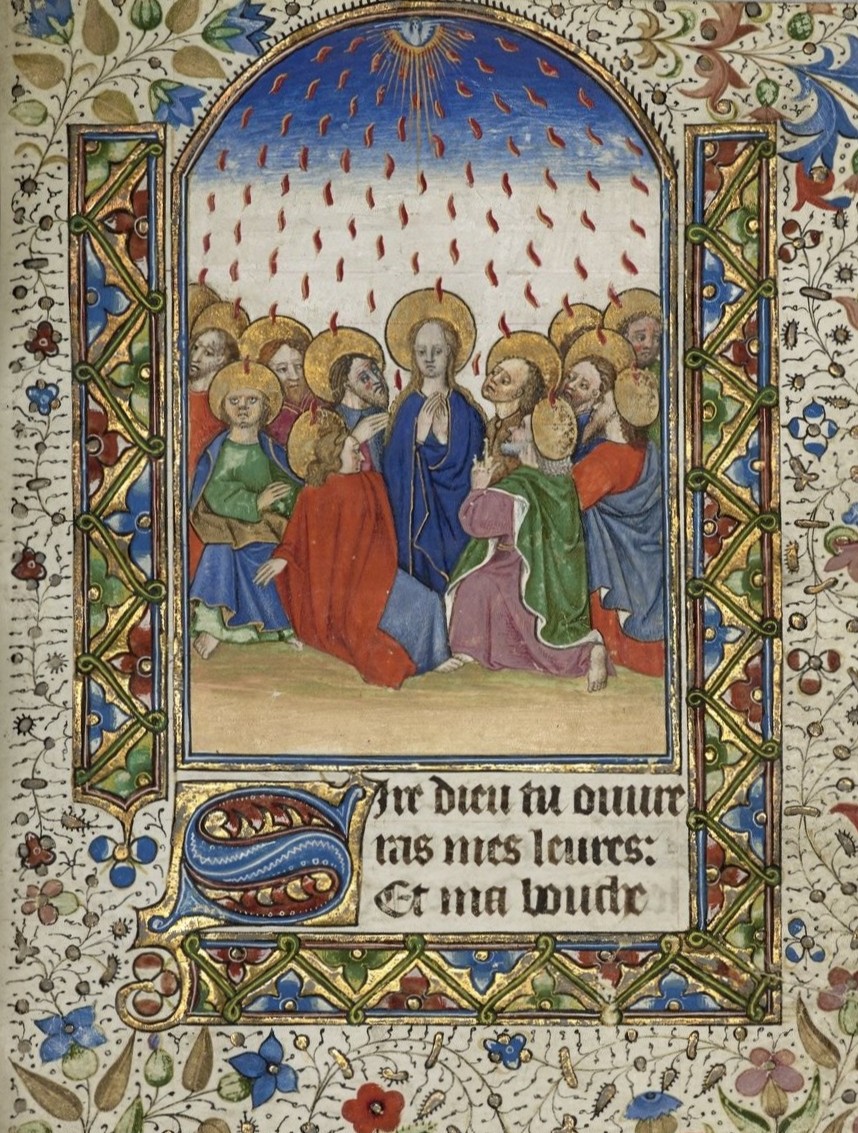
ill. 2. Master of Foljambe, Pentecost, c. 1460-1470. Book of Hours for the use of Paris. Paris, BnF, ms. NAL 28877. © Bibliothèque nationale de France, Paris.

ill. 3. Master of Foljambe, The twofold nature of Antichrist, c. 1460-1470. Livre de la Vie de notre Seigneur. Oxford, Bodleian Library, ms. Douce 134. © Bodleian Libraries, University of Oxford.
The Book of Hours in Paris is stylistically the closest to the Foljambe Hours and most probably dates from the beginning of the artist's career. The Vie de notre Seigneur, held in Oxford, is the second volume of a series of three manuscripts (two of which are preserved in Grenoble) that were made for the Grande Chartreuse near Grenoble. The miniature preserved in Philadelphia is stylistically extremely close to the present miniature: they both must date from the later phase of the artist's career. It is tempting to hypothesize that these two miniatures come from the same Book of Hours. However, we currently have no concrete evidence to support this theory.
Commentary
The miniature at hand depicts Saint Luke - identifiable by the presence of his symbol, the winged bull, as well as by the inscription on the phylactery held by the bull: "S[anctus] Lucas Evangelista". The Saint, sitting at his desk, is writing his Gospel (he holds his pen in his right hand and his inkwell in his left hand) in a study room filled with books arranged on the desk and on a shelf in the background. The desk is decorated with the coat of arms of the Dauphiné region below the coat of arms of France (simplified coat of arms, all in gold). Some amusing details, such as the little slippers before the Saint's feet, and the jugs (for water and for food) placed in a niche in the wall, are reminiscent of everyday life (ill. 4.). Below the miniature, the first lines of the Gospel according to Saint Luke are written in a gothic bastarda, with one 5-lines initial opening the text.

ill. 4. Master of Foljambe, Saint Luke at his desk (detail), c. 1465-1470. Illuminated leaf from a Book of Hours. © La Gabrielle Fine Arts SA - Nelson Iso.
Given the size of the page and the miniature, this illuminated leaf must originate from what was likely a luxurious Book of Hours. From this Book of Hours, only the miniature at hand is currently known, since no sister leaves are known (unless the miniature held in the Free Library of Philadelphia actually comes from the same Book of Hours?). We don't know who commissioned the Book of Hours, but the presence of the coat of arms is an important clue. On the side of the desk are painted the coat of arms of France, as well as the (more unusual) coat of arms of Dauphiné, most certainly indicating that the original patron or patroness of the Book of Hours was either from Dauphiné or based in Dauphiné, or, in all likelihood, both. Since Grenoble is the capital of the Dauphiné region, it is highly likely that the Book of Hours was made in Grenoble, making the present Saint Luke the one and only preserved fragment from a Book of Hours produced in a place that remains very mysterious due to the very little amount of surviving artworks.
Stylistically, this unusual miniature reveals the hand of a trained artist with a personal and inventive style. The painting is characterized by a marked brushstroke (the outlines are emphasized and sometimes enhanced with black ink) and a firm gesture that contrasts with a softer touch and a generous application of paint, adding a certain thickness to the illumination (the softer touch is noticeable for instance in the treatment of the drapery, which appears thick and soft thanks to the large amount of paint applied to the parchment). Overall, the composition is clear and readable while showing a slight misunderstanding in the conception of space (notably in the depiction of the walls, on the left and right side). The characteristics of the Master of Foljambe's style recall the illuminated manuscript production from southeastern France, particularly cities such as Lyon, Geneva, or regions like Savoy, where artists like Péronet Lamy (ill. 5.) or Jean Bapteur (also known as a painter; ill. 6.) were active and influential. This probably shows that the local tradition of Grenoble (if there was any), was highly dependent on Savoy and on the natural axis of the Rhône, which could explain the slight Provençal influence that can be perceived in the Master of Foljambe's works.

ill. 5. Péronet Lamy, A group of speakers in a discussion, c. 1440. Ciceron, Orationes. Geneva, Bibliothèque de Genève, ms. Lat. 101. © Bibliothèque de Genève, Genève.

ill. 6. Jean Bapteur, Crucifixion, c. 1440-1450. Turin, Museo civico d'arte antica. © Museo civico d'arte antica, Turin.
The face of Saint Luke shows great attention to detail, such as the wrinkles on the forehead of the saint, that are clearly marked by relatively sharp plays of shadow and light, as well as the visible teeth of the saint. Comparing the present Saint Luke with the Saint Mark in Philadelphia (ill. 7. | ill. 8.), it is obvious that - of all the manuscripts attributed to the Master of Foljambe, these two illuminations are the closest in style and therefore in date (c. 1465-1470). Some details, such as the green (used for the walls in the Saint Mark miniature and for the vault in our miniature), the motifs on the wall, as well as the black paint (used to cover some parts of the background) are so close that it is hard not to imagine that the two miniatures actually come from the exact same Book of Hours.

ill. 7. Master of Foljambe, Saint Luke at his desk (detail), c. 1465-1470. Illuminated leaf from a Book of Hours. © La Gabrielle Fine Arts SA - Nelson Iso | ill. 8. Master of Foljambe, Saint Mark (detail), c. 1465-1470. Illuminated leaf from a Book of Hours. Philadelphia, Free Library of Philadelphia. © Free Library, Philadelphia.
Despite these similarities, no information that could justify a common origin for these two illuminations is known to date. However, stylistic analysis is, in the vast majority of 15th-century cases, the decisive factor for many hypotheses, especially when no documents have been preserved or are currently unknown.
BROWSE ALL AVAILABLE ILLUMINATED MANUSCRIPTS & MINIATURES FROM THE MIDDLE AGES TO THE RENAISSANCE