FAKE!: FOUR MINIATURES BY THE SPANISH FORGER

6 April - 6 May 2026
  • FAKE!

    FOUR MINIATURES BY THE SPANISH FORGER

  • Sepia-toned portrait of Belle da Costa Greene, the first director of the Pierpont Morgan Library, shown in profile wearing a fashionable hat and lace-collar dress.
    Portrait of Belle da Costa Greene (1911) © Harvard University Center for Italian Renaissance Studies 

    The "Spanish Forger" succeeded in deceiving collectors, dealers and connoisseurs for many years, from circa 1890 up until 1930, when Belle da Costa Greene (1883-1950; see picture), one of the most influential librarians in American history, unmasked this talented forger. Belle da Costa Greene led the Morgan Library for four decades, first as the private librarian of John Pierpont Morgan and then as the institution's inaugural director after it became a public library in 1924. Her encounter with the forger took place when the Pierpont Morgan Library received an offer to purchase a painting that was then believed to be an authentic 15th-century Spanish painting by Jorge Inglés depicting the Betrothal of Saint Ursula, but which she recognized as a forgery. The nickname "Spanish Forger" therefore comes from this erroneous nationality assigned to his painting. The librarian recognized the forger's hand in an authentic antiphonary with added miniatures by the forger that she acquired for the Pierpont Morgan Library several years before, in 1909, and she then started cataloguing works by the so-called Spanish Forger.


    In the mid-20th century, about 50 works (panel paintings and miniatures) by the Spanish Forger were recognized, and this still anonymous forger soon became one of the most talented, fascinating and prolific creators of pseudo-medieval imagery of all time. He has fascinated scholars so much that a monographic exhibition was held at the Pierpont Morgan Library in 1978; the exhibition catalogue published for this occasion lists about 60 panel paintings and about 150 miniatures. Nowadays, more than 100 paintings and almost 300 miniatures are attributed to this unmatched forger. Before his identity as a forger was revealed, many of his paintings and miniatures have joined the collections of public institutions and some are even acquired by museums nowadays: in 2009, the Victoria & Albert Museum in London bought a collection of five miniatures by the Spanish Forger "for what it tells us about late 19th-century perceptions of medieval art".

  • AVAILABLE MINIATURES BY THE SPANISH FORGER

  • The Spanish Forger may not have been able to deceive forever, but he succeeded in creating a “medieval persona”, and the fact that he remains anonymous to this day just adds to the list of elements that “look medieval”.

  • Circular neo-medieval illumination by the Spanish Forger depicting a woman in a blue robe kneeling in prayer at the base of the Cross.

    The Spanish Forger's success depended on a sharp understanding of what buyers wanted medieval art to be. His miniatures and panel paintings often present courtly scenes: elegantly dressed figures frozen in ceremonial poses, richly patterned textiles, theatrical gestures, and backgrounds dotted with enchanting fortresses that can feel more like storybook stage sets than the ambiguous spaces of genuine late medieval painting. Part of the deception lay in the Spanish Forger's ability to recombine motifs from multiple European traditions into a pastiche that read as "medieval" to modern eyes but that is not a faithful historical reconstruction. Moreover, the Spanish Forger was not inventing medieval scenes; he was working from reproductions which were circulating at his time, notably Parisian illustrated editions, including sets published by Paul Lacroix between 1869 and 1882, which helped popularize "Medieval Primitives". Our miniature of The Resurrection is based on two other paintings by the Spanish Forger (a miniature in private hands and a panel in Tewkesbury Abbey) . One of the forger's most effective strategies was material: many illuminated miniatures by the Spanish Forger are executed on genuine 15th-century parchment cut from large choir books. In most cases, the forger would remove the original musical notation from one side to create a blank "medieval" surface ready for a brand new image. The medieval support itself did enormous persuasive work; viewers could be disarmed by the tactile authority of centuries-old parchment, especially since the reverse side still bears the original handwriting or musical notation. The forger was also mastering the art of imitating age: panel paintings are artificially chipped and "worm eaten" at the edges, while gold and paint show networks of cracking intended to suggest centuries of age. In his manuscript miniature paintings, the gold appears crackled or flaked to enhance the illusion of fragility, age and wear. Scientific analysis has further tightened the net around the deception by identifying pigments that were not produced before the 19th century and by noticing that the gold leaf was applied after the painting itself, while, in the medieval tradition, gold leaf was always applied first on the parchment.

  • However, the artist has left us with clues and hints that allow us to uncover the deception. Stylistically, the sweet...

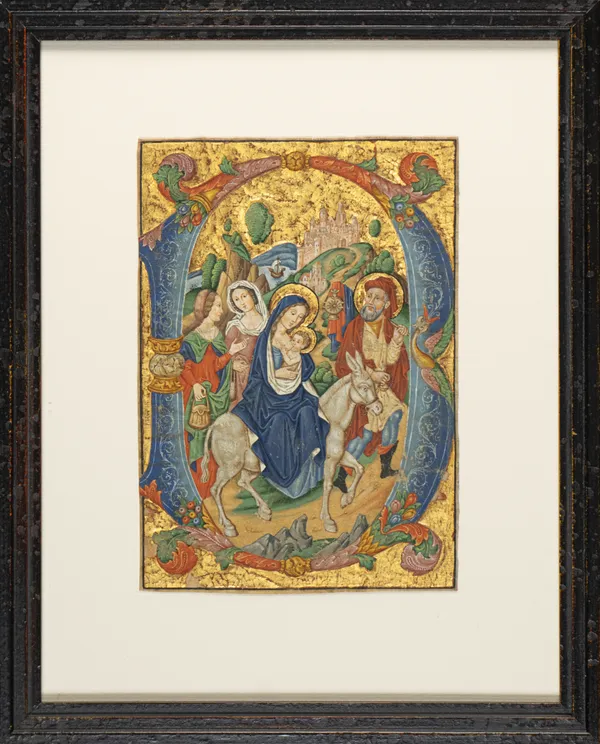
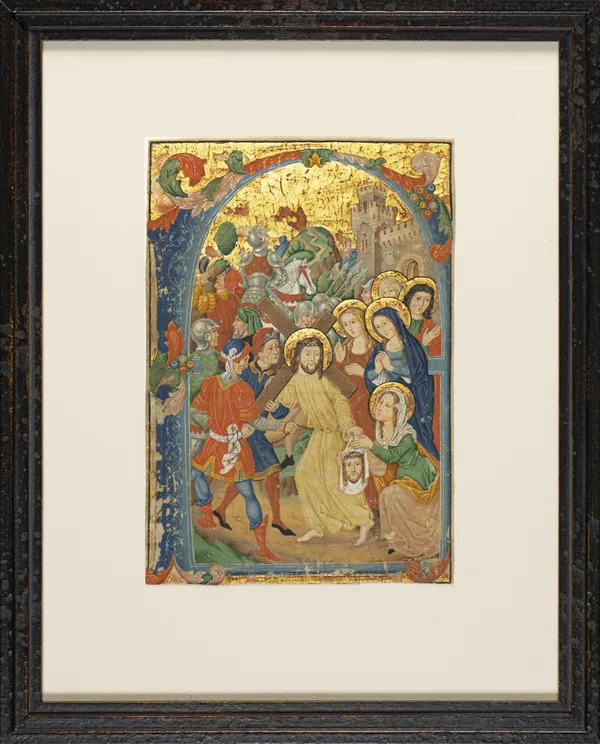
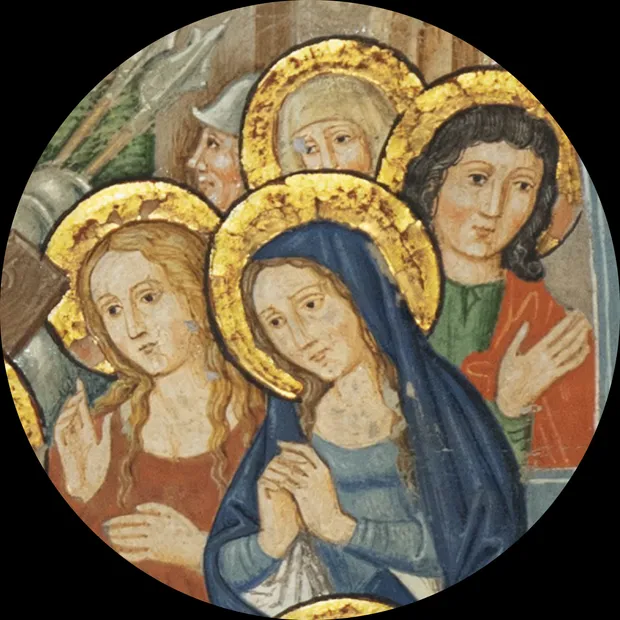
    However, the artist has left us with clues and hints that allow us to uncover the deception. Stylistically, the sweet or "doll‑like" faces of his figures (especially visible in the figure of the Virgin in our miniature of The Flight Into Egypt) and a certain theatrical staging of bodies (gestures and postures that feel posed rather than lived) are very visibly traces of modernity. Moreover, the Spanish Forger's works feature motifs that sit awkwardly with genuine medieval art: conspicuously secular court scenes inserted onto leaves taken from religious manuscripts, or female figures rendered with low necklines and a modernized sensuality that jars against authentic devotional conventions. In some works, iconographic details are troubling or mistaken (objects assigned to the wrong figures, gestures borrowed from sacred art but used in odd contexts, or symbolic elements sprinkled in simply because they "look medieval" to the eye of an avid buyer looking for medieval art). In our miniature of The Deposition, you can see, behind Saint John, a man holding a perfume jar. This perfume jar actually belongs to Mary Magdalene! In our miniature depicting The Ascent to Calvary, the woman (wearing dark orange) behind Christ and next to the Virgin Mary is, very strangely, making the gesture of Christ pantocrator.

  • The Spanish Forger’s works endure as historical documents of modern imagination. They show how forged objects can be materially persuasive, visually seductive, and culturally timed. What started as “authentic medieval” became modern forgeries and, finally, collectible artifacts of deception.

  • Black and white photograph of art forger Han van Meegeren in his studio, surrounded by chemical bottles and brushes, painting a mock Vermeer titled "Jesus among the Doctors."

    Vermeer forger Han van Meegeren (1889-1947) painting Jesus among the doctors, in 1945

    For now, the Spanish Forger's true identity remains unknown. A once‑proposed identification with the Belgian artist Ferdinand Charles François Joseph de Pape has not convinced all specialists, in part because clues place the Spanish Forger's activity in Paris across the late 19th and early 20th centuries. Reports note practical clues such as Parisian newspaper remnants found in frames, as well as the dependence on Paris‑published chromolithographs and illustrated books for compositional models. We therefore believe that the Spanish Forger was employed by a publishing house in Paris around 1890-1930. Some forgers are now identified, such as Han van Meegeren (1889-1947; see picture), the notorious Vermeer specialist forger who, in order to get out of prison - where he had been sent for selling Vermeer paintings to the Nazis - had to paint in his cell, under the watchful eyes of the police, to prove that the paintings he sold were not genuine Vermeers. What is fascinating with the Spanish Forger is that his art and his identification are now studied just like we would study the medieval artist he impersonated for years: first, we group together works by the same artist, and then we examine the possibilities for identification based on the clues provided by this body of work. The Spanish Forger may not have been able to deceive forever, but he succeeded in creating a "medieval persona", and the fact that he remains anonymous just adds to the list of elements that "look medieval".
     
    Today, the Spanish Forger's works are collected for what they are: fakes. Deliberate fabrications that shine light on the mechanisms of taste, the economics of authenticity, and the modern longing for a picturesque Middle Ages. In that sense, the Spanish Forger's art wonderfully illustrates the history of the art of deception and the history of the art market, as well as the history of the taste for the Middle Ages. The Spanish Forger embodied the Gothic Revival and took it to its extreme: forgeries. The Spanish Forger's works endure as historical documents of modern imagination. They show how forged objects can be materially persuasive, visually seductive, and culturally timed. What started as "authentic medieval" became modern forgeries and, finally, collectible artifacts of deception.