
Introduction
Antoine de Lonhy is a fascinating fifteenth-century artist whose identity was rediscovered in the late 1980s. Building on an earlier intuition by art historian Charles Sterling, this breakthrough was made simultaneously (but separately) by art historians Giovanni Romano and François Avril, who began the rediscovery of Antoine de Lonhy by merging three anonymous masters. On the one hand, Giovanni Romano identified the Master of the Turin Trinity (ill. 1.) with Antoine de Lonhy based on documented works, the commissions for which were found in archives. Later, Giovanni Romano also proposed merging Antoine de Lonhy with the Master of Saint Anne. On the other hand, François Avril considered the Master of the Turin Trinity and the Master of the Saluces Hours to be the same artist and identified this artist as Antoine de Lonhy based on the historical itinerary of Antoine de Lonhy, who was active in Piedmont and Languedoc, and who likely originated from Burgundy. In 1994, art historian Philippe Lorentz found an archival document attesting that Antoine de Lonhy was working in Burgundy in 1446 for Nicolas Rolin, chancellor to Philip the Good.

ill. 1. Antoine de Lonhy, Trinity, c. 1465-1470. Turin, Museo Civico d'Arte Antica. © Museo Civico d'Arte Antica, Turin.
Recent discoveries have greatly expanded our understanding of the artist's career, leading to a monograph published by Frédéric Elsig (2018) and a dedicated exhibition held in Susa (Museo Diocesano) and Turin (Palazzo Madama) in 2021-2022 (ill. 2.). Highly skilled, versatile, and itinerant, Antoine de Lonhy is not only an exemplary case study for 15th-century art history, but also a remarkable artist with a rich career and unique style. Far from being only an illuminator, Antoine de Lonhy also worked as a painter and a stained-glass artist. His career took him across much of Europe, from his native Burgundy to Toulouse and Barcelona, and later to Savoy and Piedmont. His artistic journey can be divided into three main phases: an early Burgundian period (1446-around 1453/1454), a Languedocian phase centered on Toulouse and Barcelona (no later than 1454-1462), and a longer Savoyard period (from 1462 to around 1490), during which he was also active in Piedmont.

ill. 2. Installation view of the exhibition dedicated to Antoine de Lonhy, 2021-2022. © Palazzo Madama.
First active in Burgundy, most probably his hometown (based on his name, Antoine de Lonhy, or "de Loigney", most probably originates from Lugny, close to Mâcon), Antoine de Lonhy worked notably for Nicolas Rolin, chancellor to Philip the Good, and bishop Jean Germain, as well as several members of the Burgundian court, such as Hugues de Clugny and Pierre de Goux. For Jean Germain, Antoine de Lonhy illuminated a Mappemonde spirituelle in 1449 (Lyon, Bibliothèque municipale, P.A. 32). For Hugues de Clugny (youngest son of Henri de Clugny, Lord of Conforgien, and member of the Burgundian nobility) and Pierre de Goux (chancellor of Flanders and Burgundy, and advisor to Philip the Good), the artist illuminated their respective Book of Hours: the Hours of Hugues de Clugny are today held in the National Library in Paris (ms. nouv. acq. lat. 3209), while the Hours of Pierre de Goux are only known through several detached leaves, including a miniature of Saint Claudio of Besançon which used to bear the coat of arms of the original owner (sold by us to a private collector). Documented in Toulouse in 1454 (the date inscribed on the wall painting executed by Antoine de Lonhy at the Dalbade - now in Toulouse, Musée des Augustins), Antoine de Lonhy worked for the Capitouls of the city and for important historical figures, such as the archbishop of Toulouse, Bernard de Rosier, for whom he most certainly painted a now dismembered missal. From this manuscript, two stunning illuminated leaves are known: the Crucifixion held in Prague (Národní galerie, K-38660; ill. 3.) and the Majestas Domini preserved in Los Angeles (J. Paul Getty Museum, ms. 69; ill. 4.).

ill. 3. Antoine de Lonhy, Crucifixion, c. 1460. Illuminated leaf from a Missal. Prague, Národní galerie, K-3000. © Národní galerie, Prague. | ill. 4. Antoine de Lonhy, Majestas Domini, c. 1460. Illuminated leaf from a missal. Los Angeles, J. Paul Getty Museum, ms. 69. © J. Paul Getty Museum, Los Angeles.
Shortly after that, between 1460 and 1462, Antoine de Lonhy went to Barcelona, where he executed two documented works (these works allowed Giovanni Romano to link the anonymous artist with the historical personality of Antoine de Lonhy): the rose window in Santa Maria del Mar, depicting the Coronation of the Virgin (documented, 1460-1461), and the Miralles Altarpiece (documented, 1461-1462), held between Barcelona (MNAC, inv. 5088) and Peralada (Museo del Castillo). From 1462 until the end of his career, Antoine de Lonhy is documented as a resident of Avigliana (Duchy of Savoy) and was active between Savoy and Piedmont. Notable works from this later phase include the Saluces Hours (London, British Library, Add. 27697, see ill. 10.), a Book of Hours made for the House of Savoy and in which Antoine de Lonhy later completed several miniatures at the request of Yolande of France, who had become Duchess of Savoy. It is the very Book of Hours (the illuminations by Antoine de Lonhy - previously the Master of the Saluces Hours) that was attributed to the Master of the Turin Trinity, and therefore to Antoine de Lonhy, by François Avril.
Commentary
The bi-folio at hand depicts, on the recto, the rare scene of the Miraculous Draught of Fishes: in an arch bordered with gold, above the first words of the prayer for Saint Peter, Christ, on the right, stands on solid ground, his gaze directed toward Saint Peter the Apostle, who is approaching the shore with his hands clasped. Behind him, two other apostles are fishing from the boat offshore. The scene unfolds within a landscape dotted with rocks and greenery, and the atmospheric perspective is emphasized by the presence of small pale-blue mountains in the background. The miniature is framed by three richly illuminated borders, featuring red, blue, green, and yellow flowers, black scrollwork, and small golden buds.
This miniature belongs to the final phase of the illuminator's career, when Antoine de Lonhy was working between Savoy and Piedmont. It was produced around 1470-1475, most likely in Turin, and originates from an unknown Book of Hours, but a series of eleven detached miniatures from this Book of Hours is known. All of these miniatures have been, at an undetermined time, glued into a Parisian Breviary from the early 15th century, held in a private collection. The present leaf matches those miniatures extremely closely in size (with only a few extra millimeters, suggesting the others were trimmed to fit the Breviary), style, as well as state of preservation. Areas affected by slight humidity damage, for example, appear in the same way across the group of miniatures (see for example the comparison with the Virgin and Child glued in the Parisian Breviary: ill. 5. | ill. 6.).

ill. 5. Antoine de Lonhy, Virgin and Child, c. 1470-1475. Illuminated leaf from a Book of Hours (glued into a Parisian Breviary, private collection). © Sotheby's. | ill. 6. Antoine de Lonhy, Miraculous Draught of Fishes, c. 1470-1475. Illuminated leaf (bi-folio) from a Book of Hours. © La Gabrielle Fine Arts SA - Nelson Iso.
Unknown until now, the present leaf is the only one from this series that is not glued into a Parisian Breviary, suggesting another provenance and journey through time (which is further confirmed by the fact that, unlike the eleven leaves glued in the Breviary, the present work is a bi-folio). It is currently impossible to establish exactly when the original Book of Hours from which the present bi-folio originates was dismembered, but we know that it was already broken up by 1989: the Breviary, already containing the eleven miniatures by Antoine de Lonhy, was sold by Heribert Tenschert in 1989 before being sold again at auction two years later in London (Sotheby's, December 17, 1991, lot 70).
Published for the first time in François Avril's article on Antoine de Lonhy (1989), the series of miniatures is included in Frédéric Elsig's catalogue raisonné (n° 32). From a stylistic point of view, the painting at hand (alongside its companion miniatures glued in the Parisian Breviary) is very close to two Books of Hours both preserved in the United States: Baltimore, Walters Art Museum, MS W.206, and New York, Pierpont Morgan Library, MS M.57 (see comparisons: ill. 7. | ill. 8.). The paintings in these manuscripts show a similar manner, with a loose, more confident brushwork, and with forms built up through the accumulation of tiny strokes that shape the faces and emphasize the deep folds of the heavy drapery.

ill. 7. Antoine de Lonhy, Nativity (detail), c. 1470. Book of Hours. Baltimore, Walters Art Museum Ms. W.206. © Walers Art Museum. | ill. 8. Antoine de Lonhy, The Coronation of the Virgin (detail), c. 1470. Book of Hours. New York, Morgan Library & Museum, MS M.57. © Morgan Library & Museum.
The composition of the scene recalls the miniature of the same subject painted by Antoine de Lonhy in a Gradual now in Detroit (Institute of Arts, MS F.1984.6). Moreover, these paintings are reminiscent of Konrad Witz's celebrated Miraculous Draught of Fishes painted in 1444 for the high altar of Saint Peter's Cathedral, at the request of François de Metz, Bishop of Geneva (Musée d'art et d'histoire, inv. 1843-11; ill. 9.) and which, in the history of European painting, constitutes the first depiction of a topographically accurate landscape!
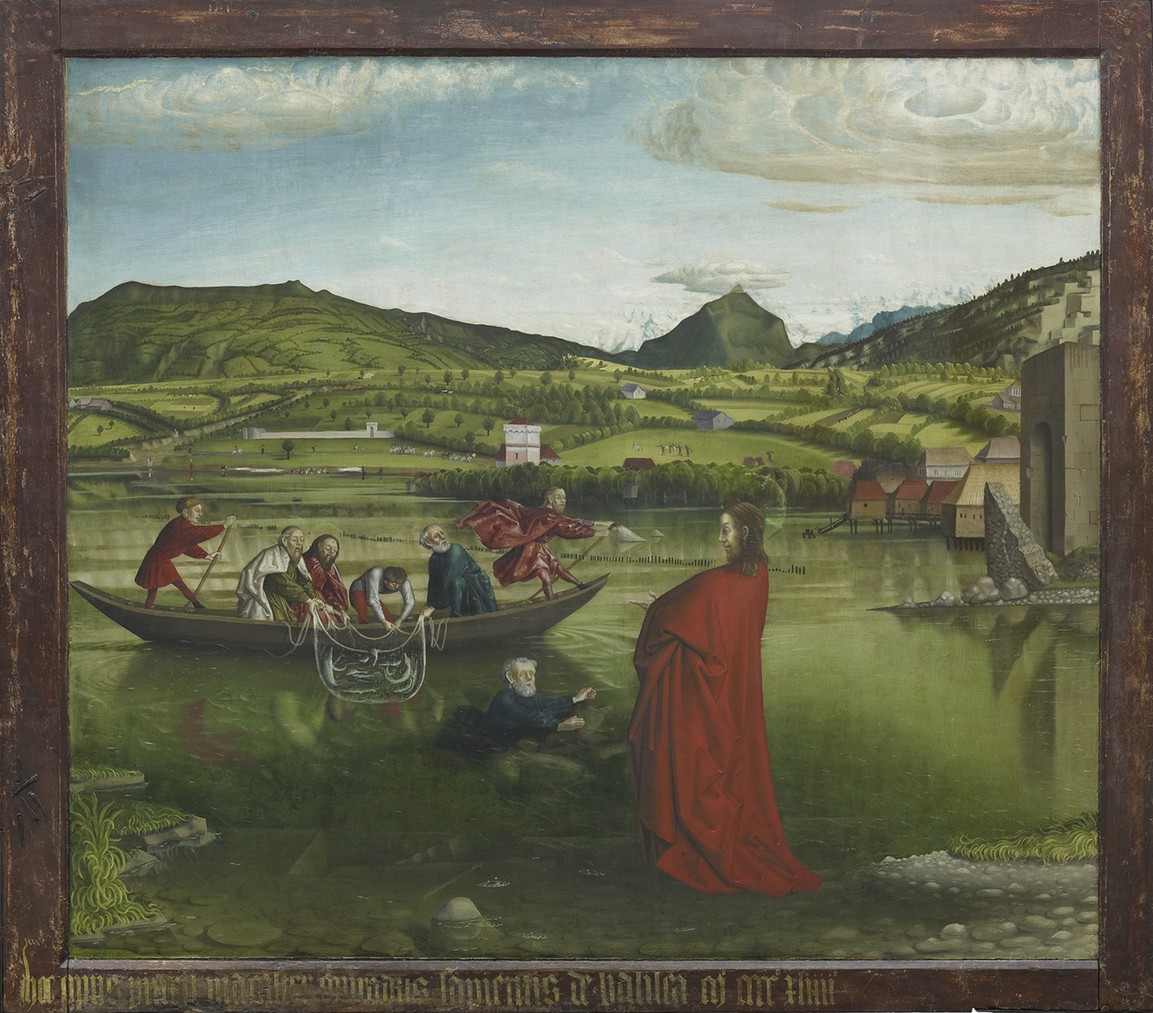
ill. 9. Konrad Witz, Miraculous Draught of Fishes, 1444. Geneva, Musée d'art et d'histoire. © Musée d'art et d'histoire de Genève.
Konrad Witz's painting had such a massive influence that most of the depictions of the Miraculous Draught of Fishes painted in the following years in nearby regions are often regarded in comparisons to the painting in Geneva. With Antoine de Lonhy, the comparison is even more important because the artist was working in Savoy. It therefore confirms the possible relationship between Antoine de Lonhy and Geneva, a relationship already established by the Saluces Hours (ill. 10.).

ill. 10. Antoine de Lonhy, Yolande de Savoie praying before the Virgin and Child, c. 1465. The Saluces Hours. British Library, MS Add 27697. © British Library.
In this manuscript, certain miniatures by Antoine de Lonhy in this Book of Hours seem to demonstrate that the illuminator was aware of the paintings by Konrad Witz, suggesting that Antoine de Lonhy may have found his way to Geneva around 1465 or shortly before, during a trip in which he could have observed the panels painted by Konrad Witz for the high altar of Saint-Pierre Cathedral. The present miniature of the Miraculous Draught of Fishes is not only of great importance for understanding Antoine de Lonhy's relationship with Savoy and the influence of Konrad Witz, but also a newly rediscovered miniature which sheds new light on a lost Piedmontese Book of Hours made in Turin around 1470-1475.
BROWSE AVAILABLE ILLUMINATED MANUSCRIPTS & MINIATURES FROM THE MIDDLE AGES TO THE RENAISSANCE