
Introduction
Among the most remarkable paintings by Swiss artist Jean-Pierre Saint-Ours (Geneva, 1752-Geneva, 1809), the Olympic Games held in the Museum of Art and History of Geneva holds a special place. Massive, highly engaging by its narrative, and perfectly painted - in the highest neoclassical style, this artwork was already celebrated during the Swiss artist’s life. Realized in Rome in the late 1780s and finished in the same city in 1791, the painting was directly acquired by François Tronchin (1704-1798), one of the greatest art collectors in Geneva.
Sixteen years later, Jean-Pierre Saint-Ours is looking back at his masterpiece and decides to produce another version of the (almost) same subject. Creating a direct continuity with his most celebrated painting, the artist depicts the moment that follows the scene of his first painting: the victorious soldier is presented to the Jury (Coronation of the winner). The present painting is the preparatory study of this monumental work depicting The Coronation of the Winner and which joined recently the collection of the Musée d’art et d’histoire. Moreover, the sketch at hand is the ultimate preparatory study realized in 1807 by Jean-Pierre Saint-Ours, who died in 1809.
Commentary
Born in Geneva in 1752, Jean-Pierre Saint Ours (ill. 1.; by his dauther Catherine Saint-Ours) was first trained by his father, Jacques Saint-Ours. The young artist moved to Paris and joined the Académie royale de peinture et de sculpture first, the workshop of Joseph-Marie Vien then. At twenty-eight years old, Jean-Pierre Saint-Ours won the prestigious Prix de Rome, conferred (almost) every year by the Académie royale de peinture et de sculpture to the best work produced. Traditionally, the artist who receives the Prix de Rome is also awarded with a fully paid trip to Italy, in the Villa Medici, intended to allow the painter to study up close the paintings of the Masters. However, in the Catholic city of Paris, Jean-Pierre Saint-Ours was not only a foreigner but also a Protestant. The Académie royale therefore refused to grant him the traditional reward for his Prix de Rome, leaving Jean-Pierre Saint-Ours to travel to Rome by his own means.
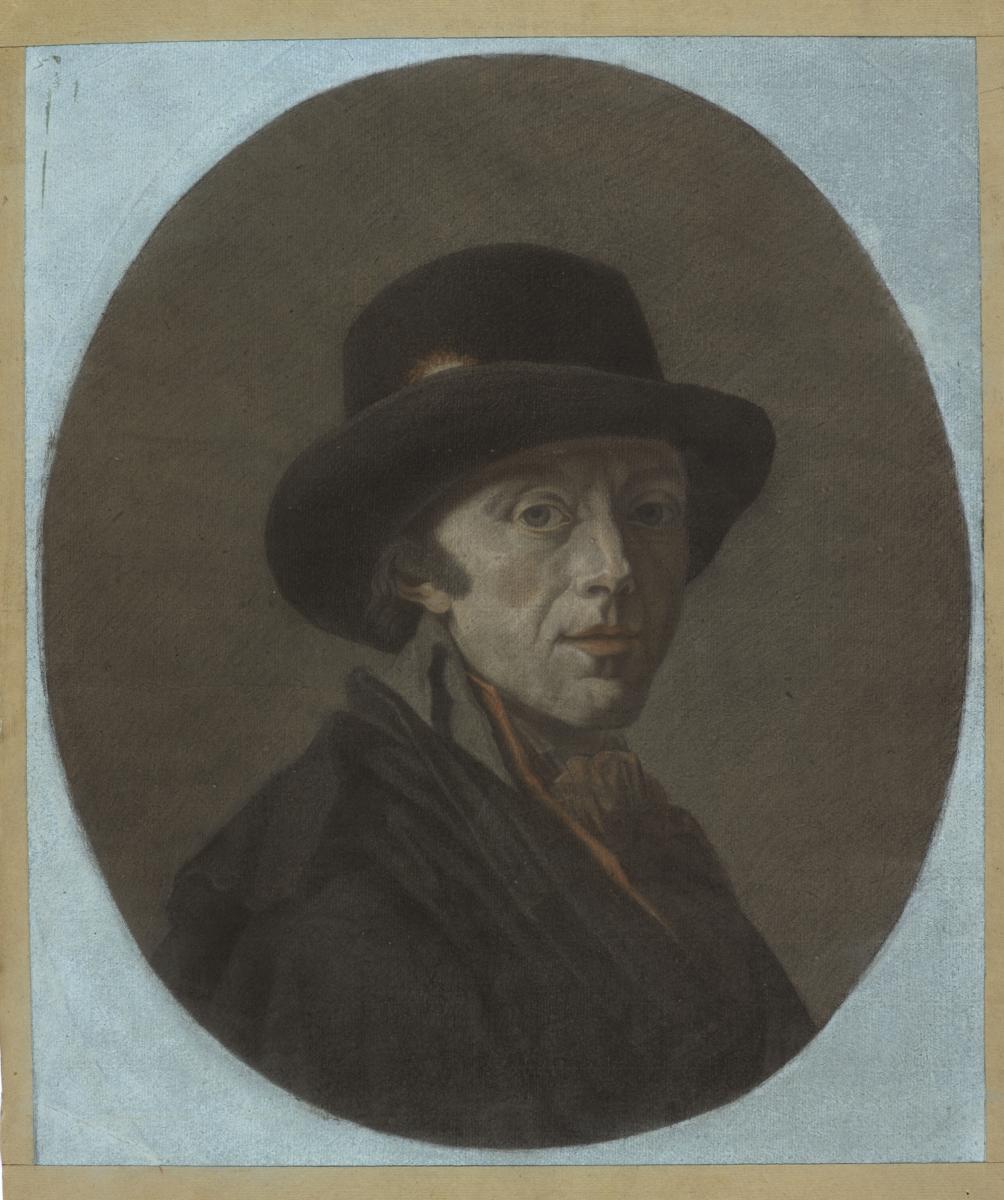
ill. 1. Catherine Saint-Ours, Copy after the self-portrait by Jean-Pierre Saint-Ours from the Geneva Society of Arts, mid-19th century. © Musée d'art et d'histoire, Genève.
The Swiss artist stayed no fewer than twelve years in the Eternal City. There, he made the customs of Ancient Greece his favorite themes of depictions, taking another direction than his contemporaries who, in a more expected way, chose to depict the heroic imageries of the past. Among some of the most powerful paintings realized by the Swiss artist while he was in Rome, we should mention the Selection of Children in Sparta (ill. 2.). If the final painting is stylistically clear, fresh, well balanced and legible, the subject and the clever composition make the work highly expressive. Jean-Pierre Saint-Ours’s attention to the expressiveness of his figures is strikingly apparent in some of his preparatory drawings, where lines focus on position, gesture and emotion, as we can clearly see with this beautiful pen and ink preparatory drawing from the Gosse-Maillart collection. Jean-Pierre Saint-Ours came back to his native city in 1792 and taught at the Société des arts de Genève. He also got involved in local politics, as an elected representative in the National Assembly and a member of the Legislative Committee, and was involved in the circle of important people of the city: his painting Allegory of the Republic reflects his political involvement, and his drawing Project for Charles Bonnet’s tomb (1793) shows his connections with the famous naturalist and philosophical writer.
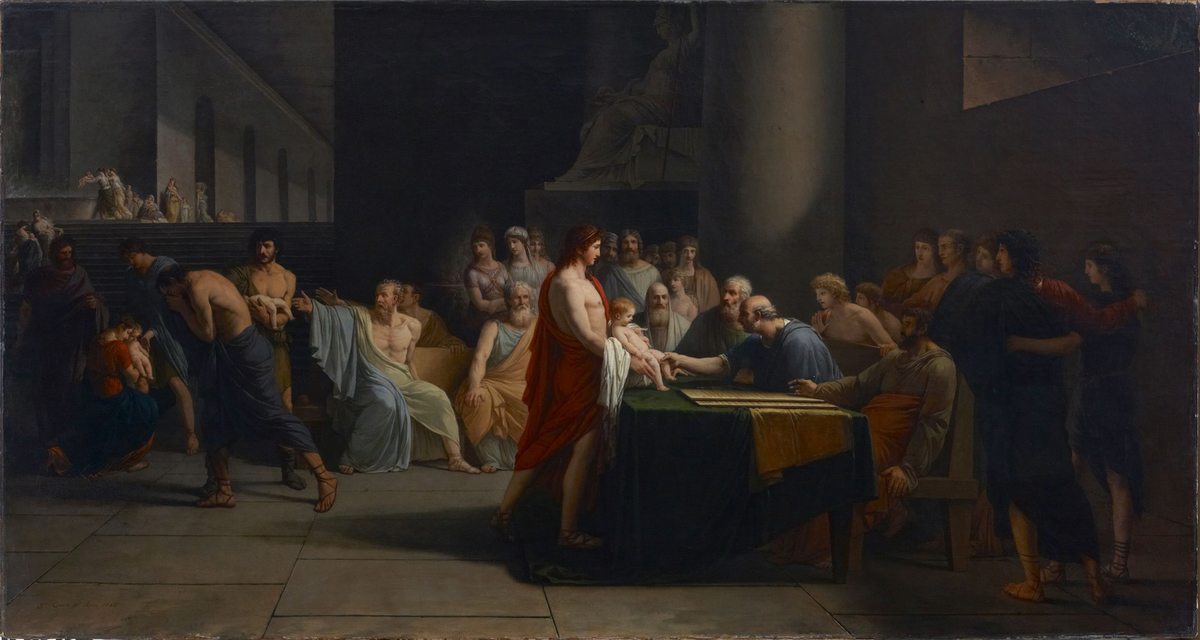
ill. 2. Jean-Pierre Saint-Ours, The Selection of Children in Sparta, 1785-1786. © Musée d'art et d'histoire, Genève.
Dating from the very end of Jean-Pierre Saint-Ours’ career and executed two years before his trespassing, the present painting is the artist’s ultimate preparatory study. On the center of the composition, the winner of the fight, wearing nothing but a white robe, is being presented by a figure wearing a red garment to the Jury. Composed of old men wearing togas of several colors, the Jury is seated at the entrance of a temple. On the left side of the image, the losing fighter is being carried away by two male figures. The background is beautifully animated by the public of the scene as well as another temple, on the left. The brushstroke is rapid and approximate, giving the work expressiveness and revealing the artist's gestures. This study gave birth to the final painting (ill. 3.), which was recently rediscovered in the collection of the Hôpitaux Universitaires de Genève (HUG) and which, even more recently, joined the collection of the Musée d’art et d’histoire de Genève.
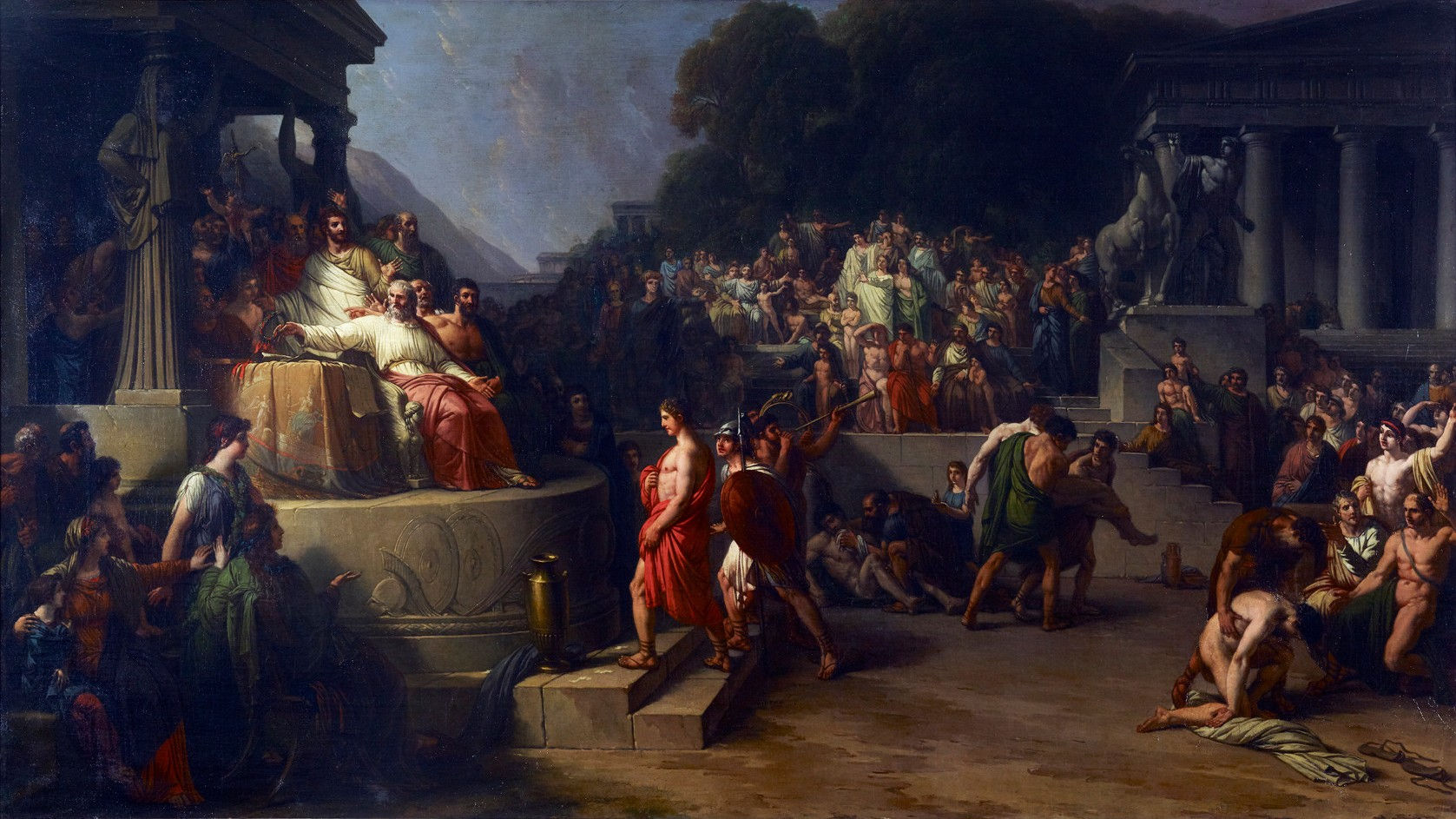
ill. 3. Jean-Pierre Saint-Ours, The Coronation of the Winner, 1807. © Musée d'art et d'histoire, Genève.
This impressive, large and purely neoclassical painting is one of Jean-Pierre Saint-Ours’ most interesting works, as it constitutes a direct continuity with his most important work: the Olympic Games (ill. 4.). At the end of his career, Jean-Pierre Saint-Ours seems to reflect on his work and delivers a kind of swan song, with a painting - and a preparatory sketch - that references his most celebrated work.
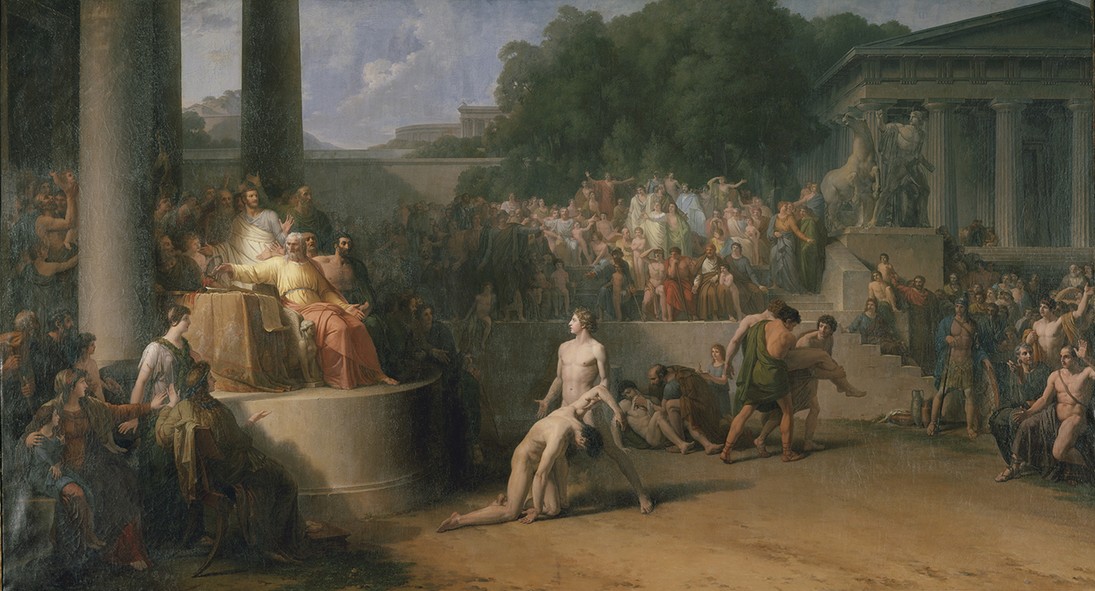
ill. 4. Jean-Pierre Saint-Ours, The Olympic Games, 1791. © Musée d'art et d'histoire, Genève.
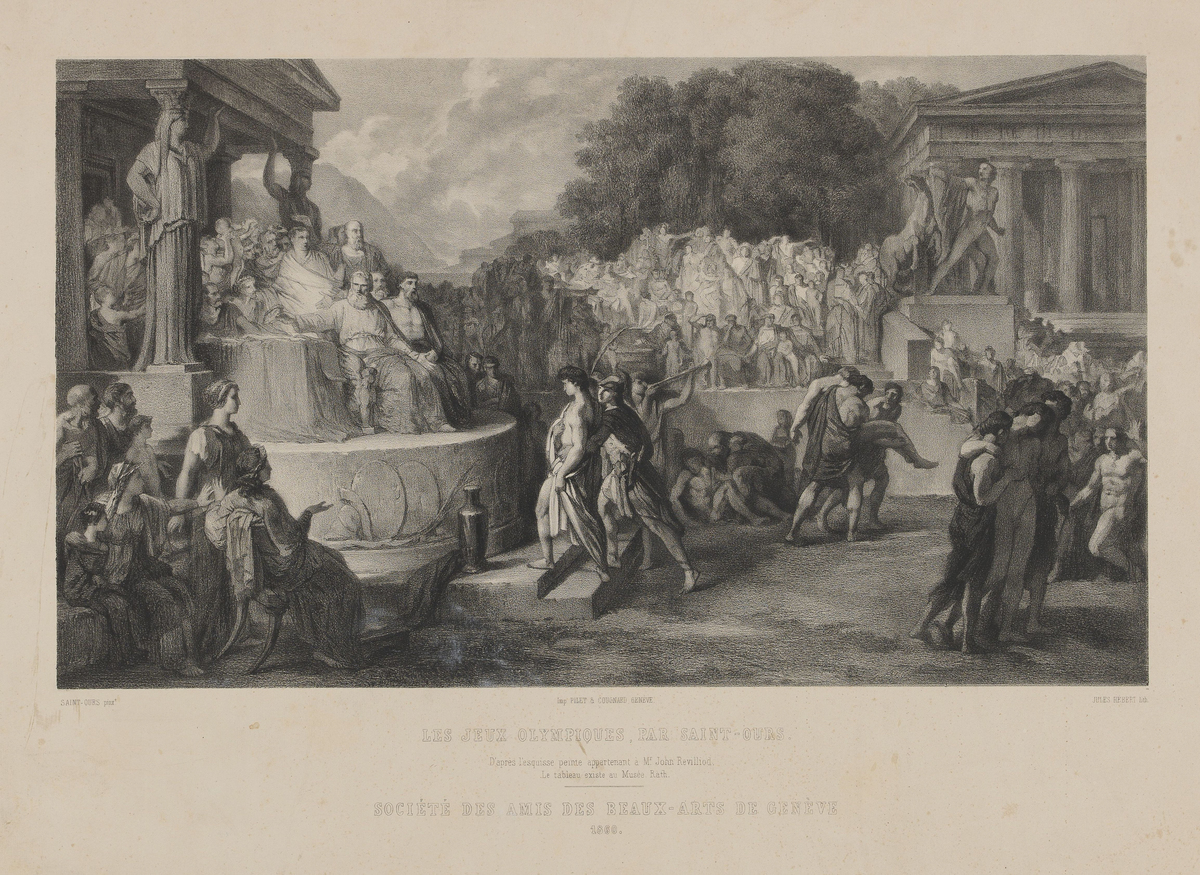 ill. 5. Jules Hébert, The Olympic Games (or The Coronation of the Winner), 1860. © Musée d'art et d'histoire, Genève.
Moreover, the study at hand has a fascinating and well-documented provenance. In 1860, Swiss artist Jules Hébert (Geneva, 1812-Geneva, 1897) executed a lithograph of the preparatory study (ill. 5.). As preparatory sketches were very rarely lithographed, it must mean that, at the time of Jules Hébert, the preparatory sketch at hand was seen as an independent work worth of being lithographed, just like a final painting. This lithograph bears the inscriptions “d’après l’esquisse peinte appartenant à Mr John Revilliod” (i.e., after the painted sketch belonging to Mr. John Revilliod). We therefore know that John Revilliod (1798-1875), director of the Bank of Commerce of Geneva, owned the present sketch. The lithograph also shows the inscription “Société des amis des Beaux-Arts de Genève” (i.e., Society of Friends of Fine Arts of Geneva), an institution founded in 1822 whose purpose is to promote and support culture and the arts. With this goal in mind, the society held lotteries where participants had the chance to win a canvas. In some instances, lithographs of these works were printed and distributed as consolation prizes. It is therefore possible that the present sketch was offered to the Société des amis des Beaux-Arts by John Revilliod as a prize for one of these lotteries.
BROWSE AVAILABLE MASTER WORKS & COLLECTIBLES FROM THE MIDDLE AGES TO TODAY