
Introduction
The Master of Rohan stands out as one of the most fascinating French illuminators of the first half of the 15th century. He is named after his masterpiece, the Grandes Heures de Rohan, a spectacular Book of Hours likely commissioned by Yolande of Anjou around 1430 and now housed in Paris (Bibliothèque nationale de France, ms. lat. 9471). Described as an "extraordinary" artist by art historians Millard Meiss and François Avril, the Master of Rohan has been the subject of many discussions. To this day, the origins of his unusually expressive style remain a mystery: Jean Porcher saw a Catalan origin, Gete Ring and Léon Marie Joseph Delaissé a German connection, while Erwin Panofksy defines the master as a "'magnificent barbarian" (see Further readings on the Master of Rohan and his workshop, below).
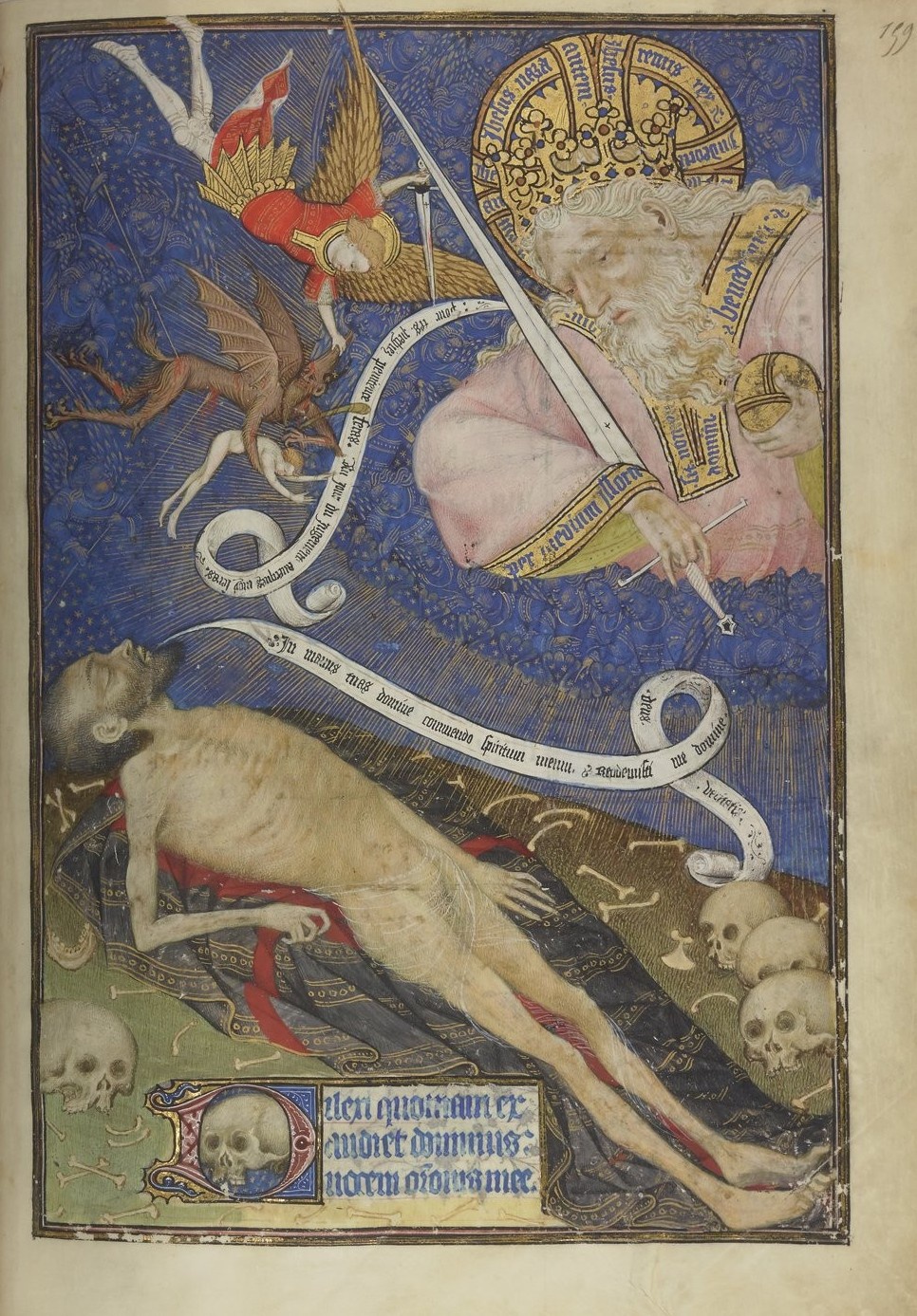
The Master of Rohan, Pietà. c. 1430. Grandes Heures de Rohan. Paris, Bibliothèque nationale de France, ms. lat. 9471.
The influence of the Master of Rohan on his contemporaries is important: many illuminated manuscripts show stylistic similarities with the Master of Rohan's style, but the high quality and the unique expressiveness remain unmatched. Several attempts were made to isolate different hands working alongside the Master of Rohan in his manuscripts, none of which are truly convincing. Given the spread of the master's style, we therefore tend to consider that the Master of Rohan might have been at the head of a small workshop. Manuscripts specialist Inès Villela-Petit proposed to isolate one illuminator, named by her the Master of Giac (after the Book of Hours made for a woman of the Giac family, now housed in Toronto, Royal Ontario Museum, ms. 997.158.14). She states that the Master of Giac could be the predecessor or the master of the Master of Rohan, but strangely, the Master of Giac is active in the same cities and at the same time as the Master of Rohan. The Master of Giac's name is sometimes used for some of the lower quality illuminations in manuscripts in collaboration with the Master of Rohan himself or for manuscripts stylistically close to the Master but less precious. If that's the case, it would be more logical to imagine that the Master of Giac was trained by the Master of Rohan, not the other way around.
We thank Peter Kidd, Christian Etheridge, and Natale Roman for their help regarding the provenance research.
Commentary
Scholars' studies have helped to understand the career of this true "eccentric Frenchman with a personal vision", to quote Sandra Hindman. The Master of Rohan was surely first active in Troyes, likely his hometown, at the dawn of the 15th century. From this period dates for example the Book of Hours for the use of Troyes now in Chantilly (Bibliothèque du château, ms. 67) or the Book of Hours (use of Troyes) now in Paris (Bibliothèque de l'Arsenal, ms. 647). The Master of Rohan then worked in Paris, collaborating with leading illuminators from 1415-1420 onwards. For instance, he collaborated with the Master of Bedford and the Master of the Cité des Dames on an exemplar of the De Casibus by Boccaccio (translation of Laurent de Premierfait), now in Paris (Bibliothèque nationale de France, ms. fr. 226). From c. 1425 to c. 1440, the Master of Rohan worked for the House of Anjou, illuminating some of his most beautiful manuscripts for them, such as the Hours of René d'Anjou (Paris, Bibliothèque nationale de France, ms. latin 1156A), or the Hours of Isabelle Stuart (Cambridge, the Fitzwilliam Museum, ms. 62). It was either at the end of his Parisian period, around 1420, or at the beginning of his establishment in Angers, around 1425, that the Master of Rohan and his workshop painted the two folios we present here, whose history is particularly fascinating.
The present two illuminated leaves depict 1. the Patroness in Prayer before the Virgin and Child and 2. the Flight into Egypt. These leaves come from a well-known and very interesting Book of Hours, commonly called the "ex-Boerner manuscript" in reference to the auctions sale held by the dealer C. G. Boerner, in Leipzig in 1912 and 1913 (see Provenance, below), in which the Book of Hours was presented (see for instance: S. Hindman, Medieval and Renaissance miniature paintings, Akron, Bruce Ferrini Rare Books & London, Sam Fogg Rare Books & Manuscripts, 1988, p. 49, 122). However, the name "ex-Boerner manuscript", which was very generic, was recently replaced by the "Heures dites Thouroude" (i. e., the so-called Thouroude Hours) by specialist Nathalie Roman (see her article: "Paul Durrieu (1855-1925): art collecting and scholarly expertise", in: The Pre-Modern Manuscript Trade and its Consequences, ca. 1890-1945, ed. L. Cleaver, D., Magnusson, H. Morcos & A. Rais, Arc Humanities Press, 2024). The so-called Thouroude Hours is obviously much more fitting, as it refers to the Thouroude (or Thouroulde, Théroulde) family, originally from Rouen, who owned the Book of Hours as early as the 15th or 16th century. The 1913 auction catalogue, which is much more detailed that the 1912 catalogue, indicated that numerous handwritten inscriptions, the oldest apparently datable to the 15th century, list the names of members of the Thouroude family, the last of whom died in 1812.
It is therefore very much possible that the Book of Hours was commissioned by the Thouroude family, and more precisely by the very woman of this family who is depicted in prayer before the Virgin and Child on one of the two present illuminated leaves. Not much is known about the Thouroude family, but some members are documented and seem to have had an enjoyable reputation, such as Guillaume de Thouroude, advisor to the King (documented in Rouen in the 16th century). It is also very interesting to mention that Jacquet Thouroulde is documented in Rouen in the second half of the 15th century, as a sculptor active in the construction site of the Cathedral of Rouen, where many other important artistes where working, such as Georges Trubert's brother Pierre Trubert. Since some of the members of the Thouroulde family are also documented in Paris, it is possible that they heard of the Master of Rohan's workshop in the capital.

Auction catalogue, Leipzig, C. G. Boerner, November 28, 1912.
According to the 1913 auction catalogue, the Book of Hours remained in the hands of the Thouroude family until the early 19th century (the most recent inscription dated 1812). It is unknown how the manuscript ended up, one hundred years later, in the 1912 sale of the dealer C. G. Boerner in Leipzig. However, from that date until today, the provenance of the Book of Hours and its detached folios are well-documented. We know that the manuscript was dismembered in France between 1925, the date of its last appearance in its original state (Paris, Me Henri Baudoin auctioneer, November 30, 1925, lot 71), and 1937, when seventeen of the eighteen illuminated leaves from the collection of Georges Aubry (painter, art dealer and collection; 1885-1968) that adorned the Book of Hours were offered on the Parisian auction market (Paris, Hôtel Drouot, February 22, 1937, lots 36 to 52; see Provenance and Sister leaves, below). A few leaves must have been unsold, as they appear two years later at auction, also from the collection of Georges Aubry (Paris, Hôtel Drouot, February 13, 1939, lots 25 to 28: King David, Presentation to the Temple, Saint Marc, and Saint Matthew). These four lots were subsequently in the collection of Florence Goud, in New York, and later sold together in 1985 (New York, Sotheby's, April 25, lot 90). Thanks to the 1913 auction catalogue, we know all the miniatures that were part of the Thouroude Hours, but today, only a few pages are located. Amongst them, it is worth mentioning the beautiful miniature of the Visitation, which is now in the Museum of Fine Arts in Stockholm.
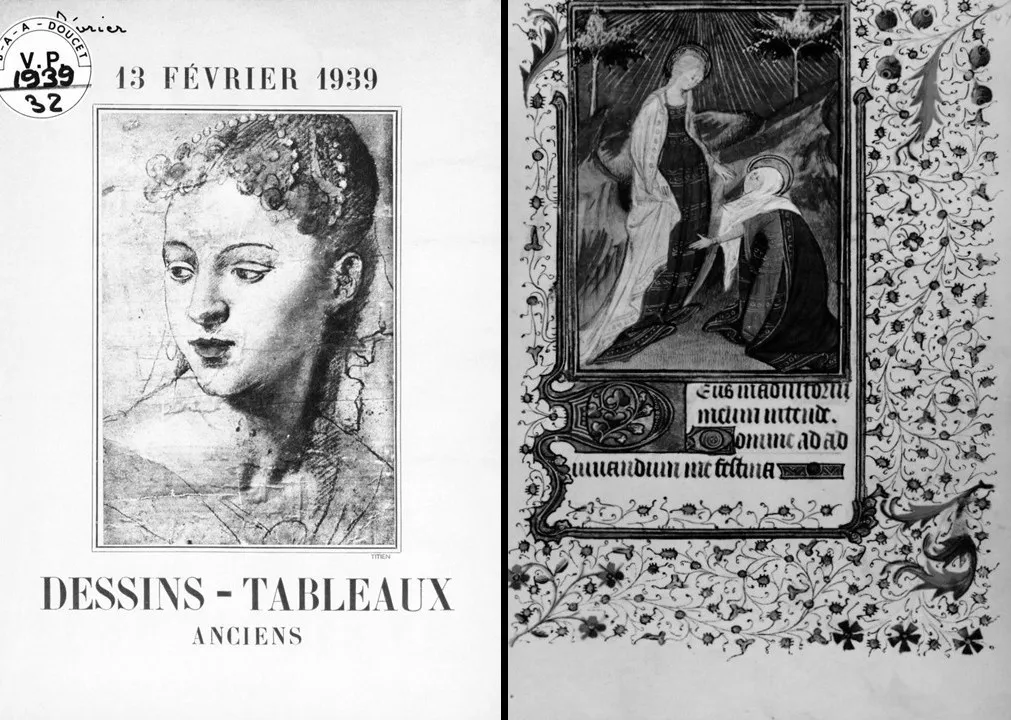
Left: auction catalogue, Paris, Hôtel Drouot, Me Beller, February 22, 1937 | Right: The Master of Rohan (and workshop), The Visitation, c. 1420-1425. Thouroude Hours. Stockholm, nationalmuseum, NMB 1906.
It is interesting to mention that as early as 1913, the miniatures of the Book of Hours were compared to the illuminations in the Grandes Heures de Rohan (even if it was, at this time, sold as a manuscript realized in Brittany, most certainly because of the origine of the Thouroude family). In the 19125 and 1937 auctions catalogues, the experts mentioned stylistic similarities with Lescuier d'Angers, a hypothetical identification for the Master of Rohan that was proposed by Paul Durrieu in 1912, but that is now abandoned. As early as the 1930s, the Book of Hours from which these two folios originate attracted the interest of art historians, who have frequently mentioned it in articles or books, attributing it to the Master of Rohan himself or his workshop: for Adelheid Heinmann, Carl Nordenfalk or Natalie Roman, the so-called Thouroude Hours are painted by the workshop of the Rohan Master, while Jean Porcher, Millard Meiss and Sandra Hindman attribute the miniatures of the Book of Hours to the Master of Rohan himself (see Published in, below).
From a stylistic point of view, these two illuminations feature strikingly expressive brushwork and ingenious staging. The paintings of the Patroness in Prayer before the Virgin and Child and the Flight into Egypt are particularly similar to the paintings of a Book of Hours produced around the same time and now attributed to the Master of Rohan and his workshop : the so-called De Buz Hours, named so in reference of its 16th century former owner, Antoine de Buz, now held in the Houghton Library (Harvard University, ms. Richardson 42).
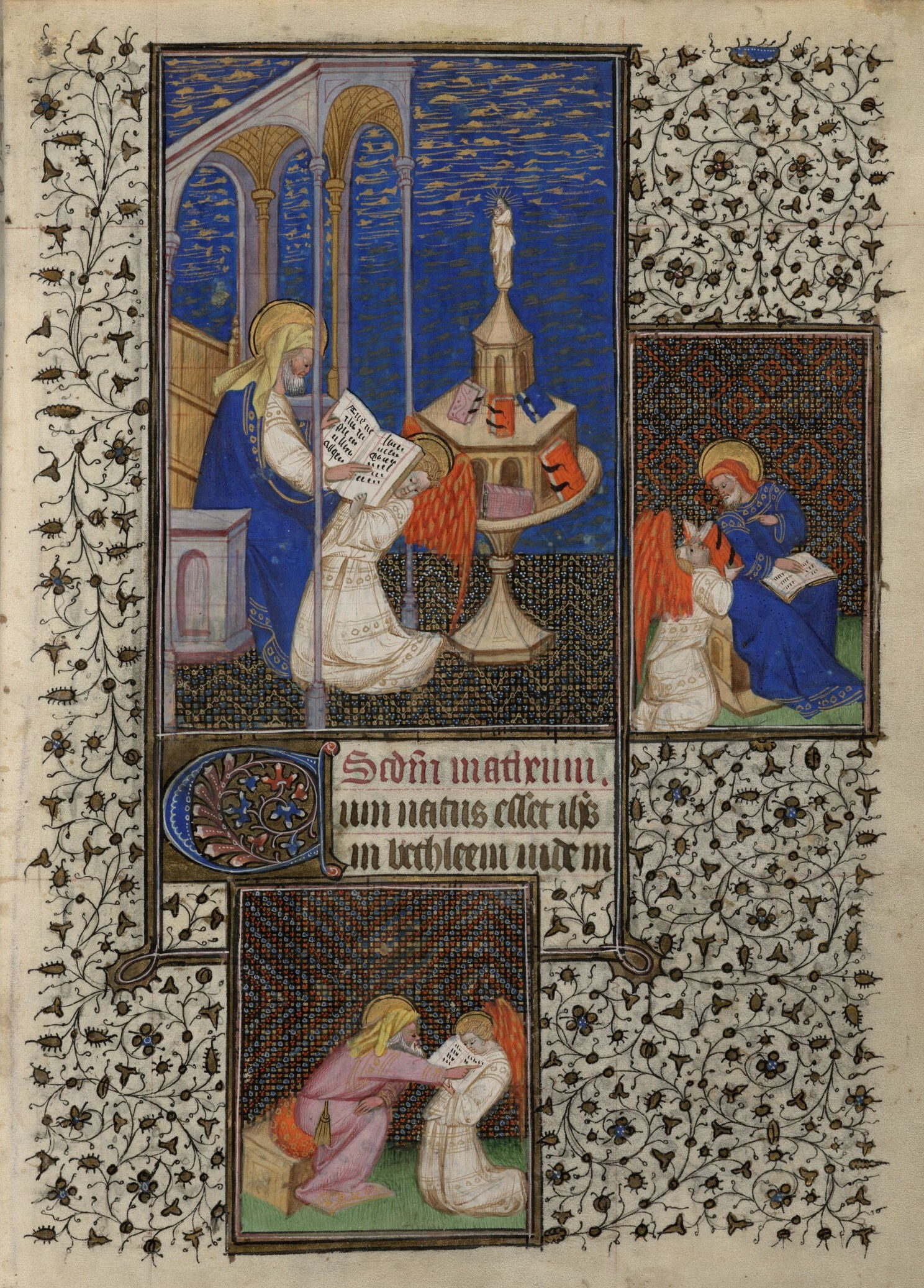
The Master of Rohan (and workshop), Saint Matthew, c. 1420-1425. De Buz Hours. Harvard University, Houghton Library, ms. Richardson 42.
A comparison of these two illuminations with the paintings in that book shows the same expressive, rapid brushwork, almost appearing scratched, as well as the same preference for elongated, sometimes disproportionate figures. In the Flight into Egypt, the motif of the angel guiding Saint Joseph and the Virgin stands out, while in the other illumination, the valuable image of the portrait of the manuscript's original patroness, most certainly a woman from the Thouroude family, depicted kneeling and in prayer before the Virgin and Child, is highly precious and serve as an witness of the network of patrons of the Master of Rohan's workshop.
BROWSE AVAILABLE ILLUMINATED MANUSCRIPTS & MINIATURES FROM THE MIDDLE AGES TO THE RENAISSANCE